
If you have spent any time on TikTok or Instagram, you have probably seen Cider. The brightly colored outfits, the “pick your mood” shopping style and the affordable prices make it easy to add a few items to your cart in minutes. But a question keeps popping up in the comments: is Cider fast fashion?
The short answer is yes. By the standard definition of the term, and according to independent sustainability raters, Cider is an online, trend-led, high-speed fashion brand that sits in the “ultra-fast fashion” category. The longer answer is more interesting, because Cider presents itself differently, and there are fair points on both sides.
In this guide you will learn what Cider is, how its business model works, what independent ratings say, where the brand’s own claims hold up and where they do not, and what to do if you want to dress well without the downsides. By the end, you will be able to decide for yourself.
The Quick Answer: Is Cider Fast Fashion?
Yes. Cider is widely classified as an ultra-fast fashion brand. It releases new styles on a very frequent schedule, sells trend-driven clothing at accessible prices, markets itself heavily through social media, and has been rated at the lowest level (“We Avoid”) by the sustainability directory Good On You.
Here is the answer in four points:
- Speed: Cider drops new items frequently, in a model often compared with Shein’s.
- Price: Its clothing is positioned as affordable and trend-focused.
- Impact: Good On You rates its environmental and labor impact as “Very Poor.”
- Claims: Cider describes its approach as “smart fashion,” but independent raters say this does not change the underlying fast fashion model.
Keep reading for the full context, because the details matter.
What Is Cider?
Cider (also written CIDER, and sold at shopcider.com) is a direct-to-consumer online fashion brand. It is a digitally native company, meaning it was built for the internet and social media from the start, rather than growing out of physical stores.
Here are the basics from public company profiles and independent reviews:
- Founded: 2020
- Base: Hong Kong
- Model: Online-only for most of its life, selling directly to shoppers through its website and app
- Audience: Young shoppers, particularly Gen Z, mostly women, with a notable plus-size range
- Funding: Venture-backed, with public profiles reporting that it has raised well over $100 million from investors that include well-known technology and growth funds
- Retail: Reported to have opened a first physical store in Los Angeles in 2026
Good On You describes the brand as “digitally native” and “social-first,” and says it makes clothes for a new generation. On paper, Good On You notes, the brand works in a way similar to Shein: it lists small batches of items every week and functions as a direct-from-factory marketplace.
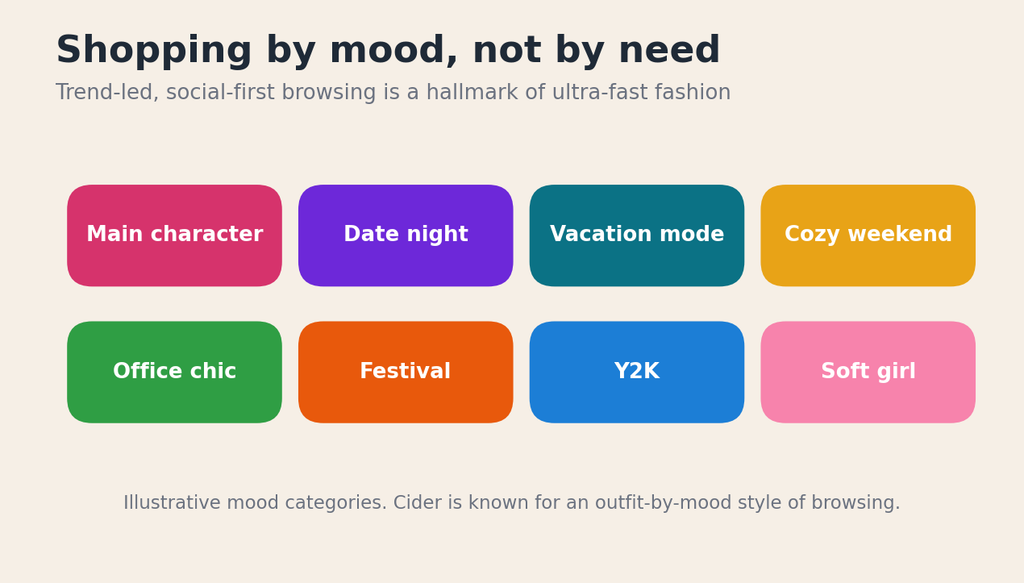
Cider is known for browsing outfits by mood rather than by need.
One feature that makes Cider feel different from a standard clothing site is mood-based shopping. Instead of only browsing by category, shoppers can browse by mood or occasion. It is a clever, fun approach, and it also nudges people to buy outfits for every feeling and event, which is exactly what fast fashion is designed to do.
What Does “Fast Fashion” Actually Mean?
Before judging any brand, it helps to be clear about the definition. Fast fashion is a business model that quickly turns current trends into cheap, mass-produced clothing and sells it in large volumes. The main ingredients are:
- Speed: New styles reach shoppers in weeks or days instead of months.
- Low prices: Cheap materials, high volume and low labor costs keep prices down.
- Short product life: Clothes are designed for a trend, not for years of wear.
- Constant newness: Fresh items appear all the time, creating urgency to buy now.
Ultra-fast fashion is the next step. It describes online-first brands that use real-time data, social media and small production runs to launch thousands of styles at very low prices, often adding new items daily or weekly. Shein is the best-known example, and Good On You places Cider in the same category.
If you want a deeper explanation of the term, read our complete guide: What Is Fast Fashion?
How Cider’s Business Model Works
Understanding the model is the key to understanding why Cider is classified the way it is. Brands in this space tend to follow a similar pattern.
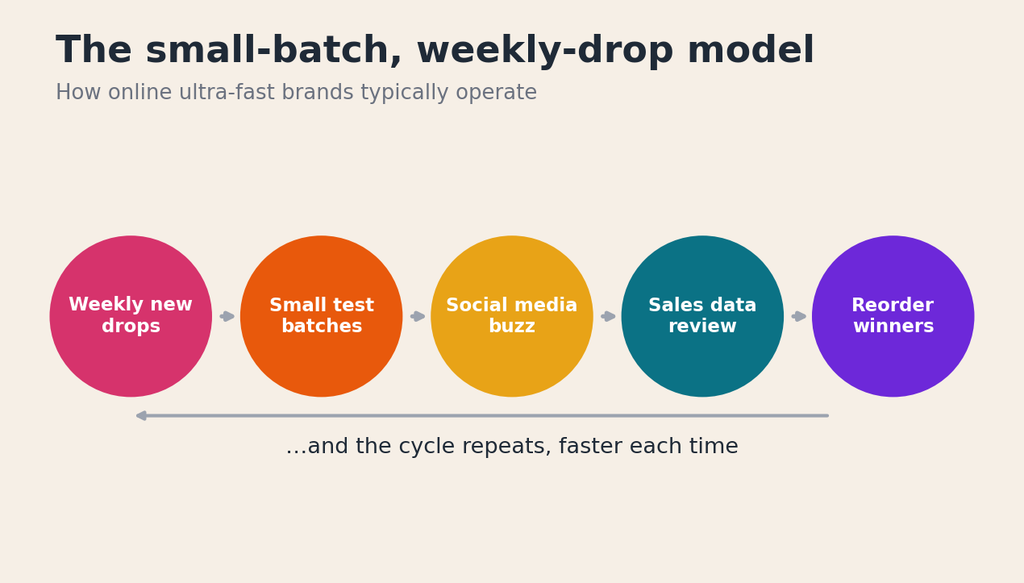
The small-batch, weekly-drop loop used by online ultra-fast fashion brands.
1. Weekly drops of new styles
Instead of releasing a few big collections a year, Cider adds new items regularly. Independent reviewers describe this as new collections arriving several times a month, with some reporting weekly drops and very large numbers of styles listed at once.
2. Small batches and testing
A common approach for this kind of brand is to produce small test batches, see what sells and then reorder the winners. Cider has described its approach as made-to-order or low-inventory, and has marketed this as a way to reduce the waste that comes with unsold stock. This is a genuine point in its favor, and we return to it later.
3. Social media as the main engine
Cider’s growth has been driven by TikTok, Instagram, influencer partnerships and a young, online-first audience. Content creators wear the clothes, followers see them, and the shop link is a tap away. Social media is also where trends spread fastest, so the brand can follow what is popular almost in real time.
4. Direct-to-consumer selling
Cider sells directly through its own website and app, without a traditional retail middleman. This keeps costs lower and gives the company a stream of customer data to guide what it makes next.
5. Low prices
Reviewers point out that low prices are made possible by inexpensive synthetic materials, high-volume production and the absence of traditional store costs. Some independent reviewers also argue that, given the frequency of releases and the price level, it would be very hard to produce at this speed without low-cost outsourced labor. That is an inference rather than a documented fact about specific factories, but it is the same logic critics apply across the whole fast fashion sector.
Signs That Cider Fits the Fast Fashion Pattern
No single factor makes a brand fast fashion. The label applies when several signs appear together. Here is how Cider lines up, based on what independent raters and reviewers report.
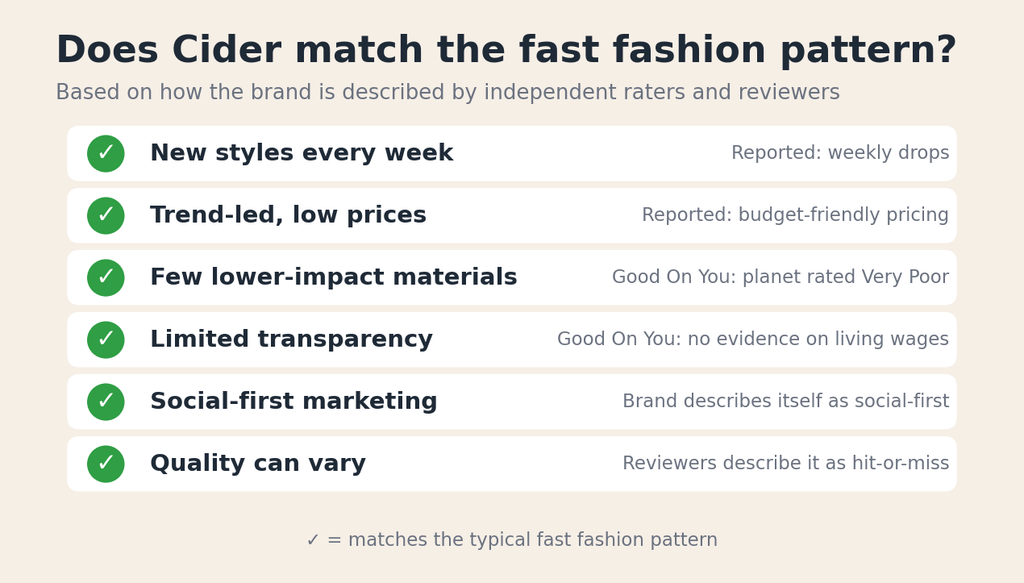
How Cider lines up against the typical fast fashion pattern.
Frequent new arrivals
Constant newness is the most obvious sign. When a brand adds new items every week, shoppers feel they must keep up, and clothes become a rapid cycle of buy, wear, replace.
Trend-led design
Cider’s catalog follows current aesthetics, from viral looks to occasion-based outfits. That is fast fashion’s core skill: spotting what is already popular and delivering it quickly.
Affordable pricing
Cider’s pricing is accessible, and some reviewers report individual items at very low prices. Low prices are not automatically a red flag, but combined with high volume they usually indicate cost-cutting somewhere in the chain.
Limited use of lower-impact materials
Good On You notes that Cider uses few lower-impact materials. The brand does have a recycled-materials line, called ReCider, but independent raters say it represents only a small part of the whole.
Limited transparency
Good On You says it found “no evidence” of key labor protections in several areas, including living wage coverage. Other reviewers also say the brand’s public information about audits and supply chain is not detailed enough to judge its claims.
Mixed quality
Some reviewers describe quality as “hit-or-miss,” which is a common result of a model that puts speed and low cost ahead of durability. Experiences vary by item, so read individual product reviews before buying.
Cider’s Good On You Rating Explained
Good On You is a well-known independent platform that rates fashion brands on their impact on people, the planet and animals. It is one of the most frequently cited sources in discussions of fast fashion brands, and its ratings run from “We Avoid” (the lowest) to “Great.”

Cider’s Good On You rating: Planet and People rated Very Poor, overall We Avoid.
According to Good On You’s brand directory:
- Planet: “Very Poor.” The rating notes the brand uses few lower-impact materials, follows a fast fashion model with quickly changing trends, and shows no evidence of action to protect biodiversity in its supply chain.
- People: “Very Poor.” The rating covers workers’ rights, including child labor policies, living wages and gender equality.
- Animals: “It’s a Start.” This is the best of the three scores, and the rating notes the brand avoids several animal-derived materials.
- Overall: “We Avoid.”
Good On You’s analysis, published in November 2023, concludes that Cider can make piecemeal improvements and increase transparency, but that as an ultra-fast fashion brand rooted in overconsumption and mass production, it cannot be considered a responsible brand without a deeper change to its business model.
An important caveat: Good On You notes that its rating may not reflect claims the brand has made since publication, and ratings are updated over time. Always check the current listing before quoting it. This is also true of any rating, and it is why we recommend reading the primary source rather than relying on summaries.
Cider’s “Smart Fashion” Claims: What Holds Up?
Cider describes its mission as creating affordable, everyday statement pieces with sustainability in mind, and has used phrases such as “smart fashion” and “made with Mother Earth in mind.” It also highlights its made-to-order approach and its ReCider line. It is fair to look at both sides.
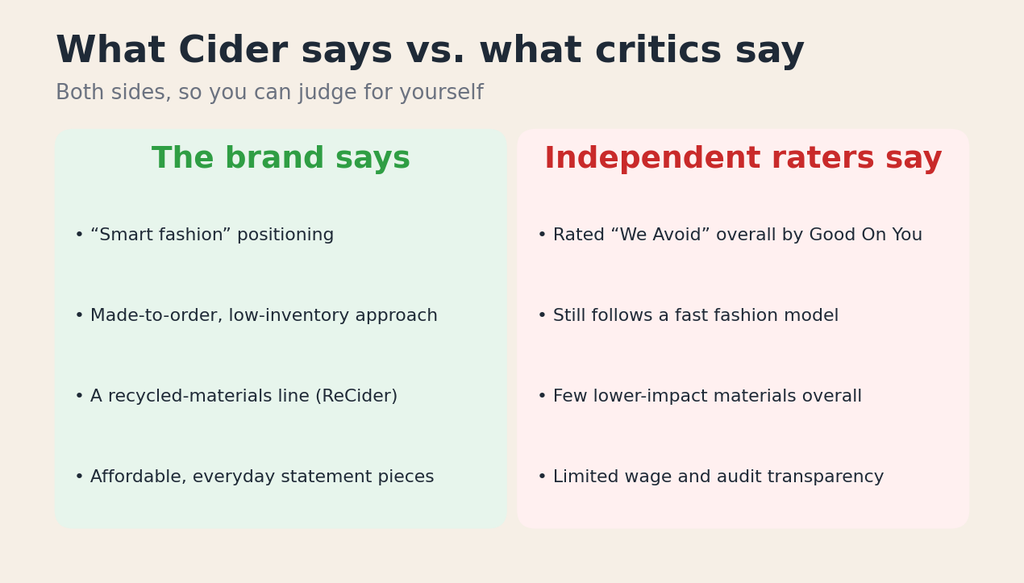
What Cider says about itself versus what independent raters say.
Points in the brand’s favor
- Lower inventory risk: Producing in small batches or on demand can reduce the volume of unsold stock, which is a major source of waste in the industry.
- A recycled-materials line: ReCider shows an effort to use recycled content, and any use of recycled fabric is better than none.
- Inclusive sizing: The brand is noted for a broad size range, including plus sizes, which many mainstream brands under-serve.
- Accessible prices: For shoppers on tight budgets, affordability matters.
Points critics raise
- The overall model is still fast fashion. Releasing new styles constantly encourages overconsumption, regardless of how efficiently each batch is made.
- Transparency is limited. Without clear data on factories, wages and audits, it is hard to verify sustainability claims.
- Recycled lines are a small slice. A single capsule collection does not offset a high-volume catalog made mostly from conventional materials.
- Language versus evidence. Several reviewers describe the “smart fashion” messaging as greenwashing, meaning marketing that makes a brand look more sustainable than its practices justify. This is a critique, not a legal finding, and Cider disputes this characterization in its own materials.
The fairest summary is this: Cider may be somewhat more efficient than some competitors in how it manages inventory, but efficiency is not the same as sustainability. A faster, smaller-batch model still depends on a large number of garments moving through the system.
Is Cider Ethical?
Ethics covers more than materials. It also includes how workers are treated, how transparent the company is and how honestly it markets itself.
Worker conditions. Cider has not published the detailed supplier information that would let outsiders verify wages and conditions. Good On You’s “Very Poor” People rating reflects a lack of evidence for key protections, such as living wage commitments. Lack of evidence is not the same as proof of harm, but it means shoppers cannot be confident either way.
Transparency. Some information exists, but critics say it is not enough. Brands with strong ethical practices tend to publish factory lists, audit results and wage data. This is one of the clearest gaps.
Marketing honesty. Be cautious with any brand that uses vague green-sounding words without specifics. Look for numbers, named certifications and independent verification.
Online allegations. You may also see social media posts accusing ultra-fast brands, including Cider, of copying designs from independent creators. These claims circulate widely online, but we have not independently verified them for this article, so treat them as allegations rather than established facts.
Cider vs. Shein vs. Zara vs. Slow Fashion
How does Cider compare with others? This table is a simplified, general comparison, not a detailed audit of any one company.
| Feature | Cider | Shein | Zara | Slow fashion brands |
|---|---|---|---|---|
| Category | Ultra-fast fashion | Ultra-fast fashion | Fast fashion | Slow / sustainable |
| New styles | Very frequent drops | Extremely frequent | Frequent, in-season | Limited collections |
| Main channel | Online, social media | Online, social media | Stores and online | Varies |
| Typical prices | Low to moderate | Very low | Moderate | Higher |
| Production style | Small batches, reorders | Small batches, reorders | Quick response, larger runs | Small, planned runs |
| Independent rating | Good On You: We Avoid | Good On You: lowest tier | Varies by review | Usually higher |
| Transparency | Limited | Limited | Moderate | Often greater |
Good On You places both Cider and Shein at the lowest level overall, although each brand has its own particular strengths and weaknesses. Neither is “good versus bad” in a simple sense. Both operate inside the same trend-driven structure.
How Does Cider’s Quality Hold Up?
Reviews describe quality as inconsistent. Since the brand sells a very large range of styles from many suppliers, some pieces are praised for fit and color while others disappoint on fabric thickness, stitching or sizing. Customers commonly report that:
- Fabrics are often synthetic, such as polyester blends, so breathability and durability vary.
- Sizing can differ between styles, so checking the size chart and reviews for each item matters.
- Washing and wear can reveal differences between items, especially with lighter, cheaper fabrics.
If you do buy from Cider, check the fabric composition on each product page, read recent customer reviews with photos, and measure yourself against the size chart rather than guessing.
Where Cider Sits on the Fashion Spectrum
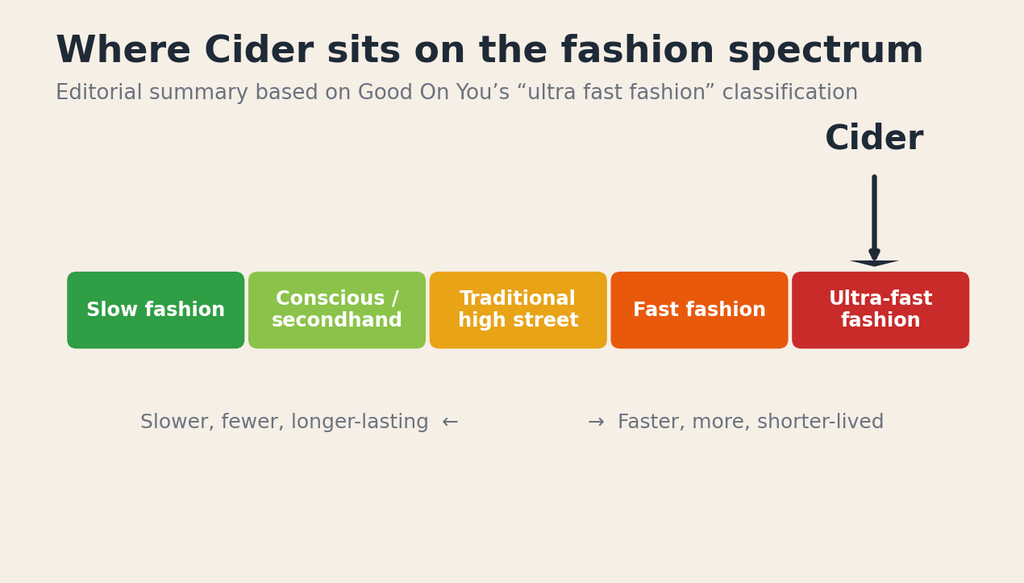
An editorial summary of where Cider sits between slow fashion and ultra-fast fashion.
Placing Cider on a spectrum helps keep the discussion balanced. It is not the only brand in this space, and it is smaller than the biggest names. But size does not change the model. A smaller ultra-fast brand still encourages frequent buying and short-term wear.
Should You Buy from Cider? A Balanced Take
There is no single right answer, because people have different budgets, values and needs. Here is a way to think about it.
It may be reasonable if:
- Budget is your biggest constraint and you need affordable clothing.
- You need a wider size range than you can find elsewhere.
- You buy rarely, choose carefully and plan to wear items many times.
You may want to look elsewhere if:
- Reducing your environmental footprint is a priority.
- You want clear proof of fair wages and safe workplaces.
- You tend to buy outfits for single occasions or trends.
Whichever path you choose, one habit makes a big difference: buy fewer pieces and wear each one more often. Even a low-impact garment becomes high-impact if it is worn twice, and even a fast fashion item has a smaller footprint if it is worn 30 times or more.
Better Alternatives to Cider
You do not need to spend a fortune to step away from ultra-fast fashion. These options work at different budget levels.
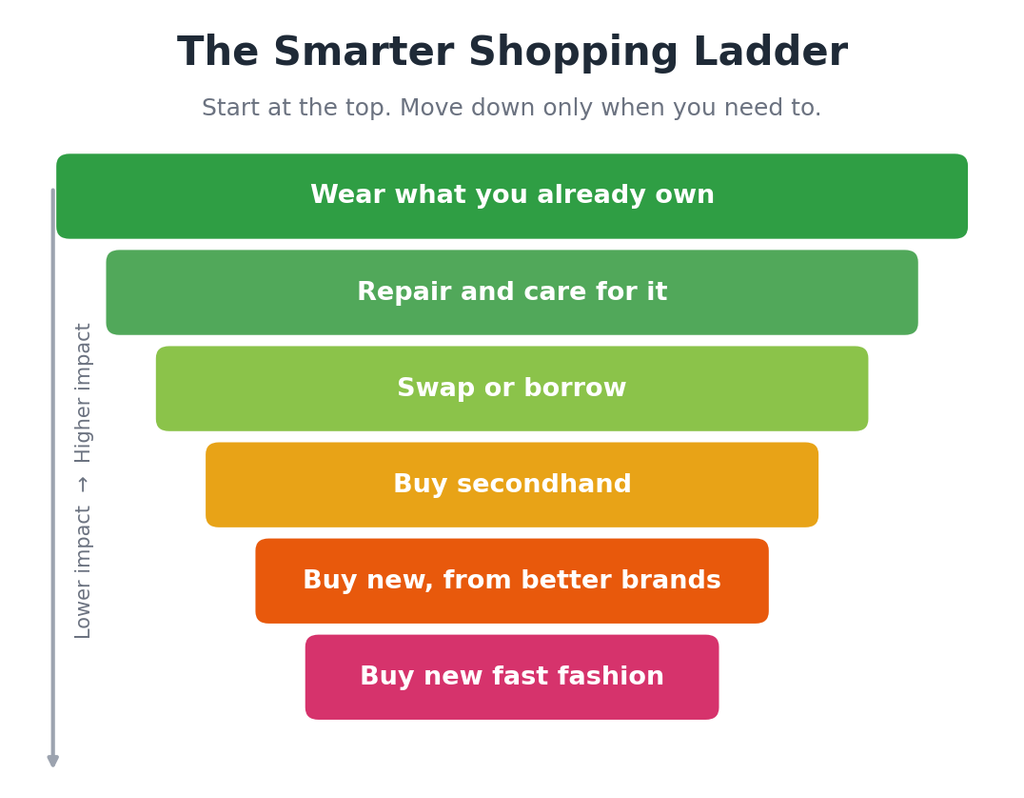
The smarter shopping ladder: start at the top and move down only when needed.
1. Shop secondhand first
Thrift stores, consignment shops and resale apps offer trendy and vintage pieces at low prices. Searching for the exact style you wanted from a fast fashion site often turns up similar items secondhand.
2. Swap and rent
Clothing swaps with friends are free. For events, renting an outfit often costs less than buying and avoids a closet item you will wear once.
3. Choose brands with transparency
Look for brands that publish factory lists, pay living wages and use certified materials such as GOTS, Fairtrade or OEKO-TEX. No label is perfect, but publicly verifiable details are a good sign.
4. Check independent ratings
Directories such as Good On You let you search a brand before you buy. Ratings change, so check the date on each one.
5. Build a capsule wardrobe
A small set of versatile pieces in a coordinated palette can create dozens of outfits. This cuts impulse buying and reduces the pressure to chase every trend.
6. Repair and care for what you own
Learn basic mending, wash less often, air-dry when you can and take garments to a tailor. Extending the life of clothes is one of the most effective things you can do.
Tips if You Still Shop at Cider
If you decide to buy, you can reduce regret and waste with a few simple habits:
- Wait 48 hours before checking out, and remove items you no longer want.
- Apply the “30 wears” test: will you wear it at least 30 times?
- Read reviews with photos and check the fabric label on the product page.
- Check sizing against a garment you already own that fits well.
- Avoid unnecessary returns, since shipping items back and forth adds to the footprint.
- Do not rely on mood or urgency: ignore countdown timers and “low stock” messages.
- Resell or donate items you do not wear, and repair what you can.
Frequently Asked Questions
Is Cider fast fashion? Yes. Independent raters, including Good On You, classify Cider as an ultra-fast fashion brand because of its frequent new releases, trend-led catalog and low-cost model.
Is Cider the same as Shein? They are not the same company, but they follow a similar model: online-first, social-media-driven, with frequent small-batch drops. Good On You places both in its lowest overall tier.
Is Cider ethical? Independent raters say there is limited evidence of strong labor protections, and the brand’s People rating on Good On You is “Very Poor.” The brand highlights its own efforts, but publicly available transparency is limited.
Is Cider sustainable? Cider promotes sustainability efforts such as a made-to-order approach and a recycled-materials line, but Good On You rates its environmental impact “Very Poor” and says it uses few lower-impact materials.
Is Cider good quality? Opinions vary. Many reviewers describe quality as inconsistent, which is common in fast fashion. Check fabric details and customer photos for each item.
Why is Cider so cheap? Reviewers attribute low prices to inexpensive synthetic fabrics, high-volume production and direct-to-consumer selling without store overheads. Critics argue such pricing usually relies on low-cost labor.
Where is Cider from? Cider was founded in 2020 and is based in Hong Kong, according to public company profiles.
What are good alternatives to Cider? Secondhand shops, clothing swaps, rental services and transparent, certified brands are good options. See the alternatives section above.
Is Cider legit? Cider is a real, venture-backed company that sells clothing directly to shoppers. Whether it is “legit” as a purchase is a separate question from whether it is ethical, so check recent reviews on shipping, returns and quality before ordering.
Conclusion
So, is Cider fast fashion? Yes. It fits the definition on speed, price, trend focus and marketing, and independent raters such as Good On You classify it as ultra-fast fashion and rate it at the lowest overall level.
At the same time, it is fair to recognize the brand’s points of difference: small-batch and made-to-order production that may reduce unsold stock, a recycled-materials line and an inclusive size range. These are positives, but they do not change the underlying model, which depends on a constant flow of new, low-priced, trend-driven clothing.
The most useful takeaway is not “never shop here” or “it is fine.” It is to shop with intention. Know what you are buying, wear it often, and look first at secondhand, swapping, repair and transparent brands. Small choices add up, and they send brands a clear signal about what shoppers value.
Read More