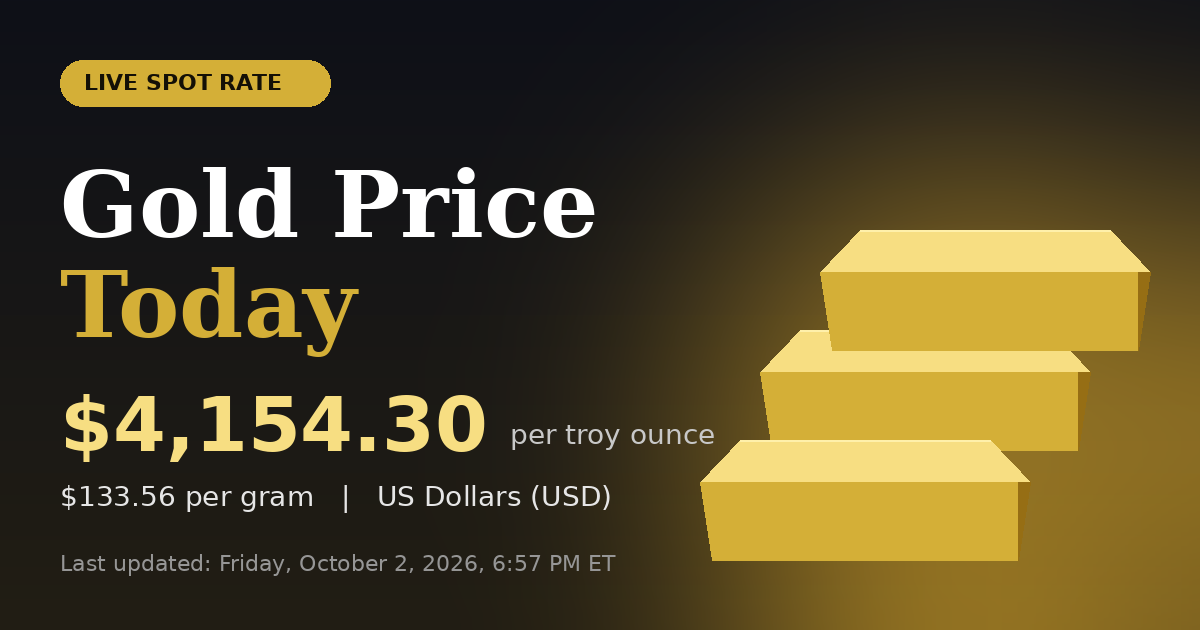
If you searched for the gold price today, here is the short answer: the last quoted spot price of gold was about $4,154 per troy ounce on Friday, October 2, 2026, which works out to roughly $133.56 per gram. Global gold trading pauses over the weekend, so that Friday-evening quote is also the latest live price on Saturday, October 3, and it stays in place until trading reopens on Sunday evening, US Eastern time.
This page does more than quote a number. Below you will find today’s price in every common unit, a breakdown by karat, the forces that push gold up and down, a short look at where the market has been, and a practical guide to buying, selling and investing. Whether you are checking the value of an old ring, comparing coins from a dealer, or just following the market, you should be able to leave this page knowing what the number means and what to do with it.
Quick note: prices on this page are a snapshot taken from live market quotes on October 2, 2026. Gold can move several dollars within minutes, so always confirm the latest quote with your dealer before you buy or sell.
Gold Price Today at a Glance
The table below shows the spot price of 24-karat (99.9% pure) gold in US dollars. The spot price is the benchmark for immediate delivery, and it is the number almost every bullion dealer, jeweler and refinery uses as a starting point.
| Unit | Gold price (USD) | Notes |
|---|---|---|
| Per troy ounce | $4,154.30 | The standard market quote |
| Per gram | $133.56 | Ounce price divided by 31.1035 |
| Per 10 grams | $1,335.60 | Common size for small bars |
| Per pennyweight | $207.70 | Used by jewelers and scrap buyers |
| Per kilogram | $133,564 | Large bar and wholesale pricing |
| Change on the day | About -$30.78 (-0.7%) | Friday, October 2, 2026 |
During Friday’s session, quotes from major price trackers ranged from roughly $4,125 at the low to about $4,225 at the high, a swing of around $100 in a single day. That is normal for gold at today’s price level, and it is a good reminder that the “price today” is really a moving target.
Last updated: Friday, October 2, 2026, 6:57 PM ET. Next update when markets reopen.
Gold Price by Karat: 24K, 22K, 21K, 18K, 14K and 10K
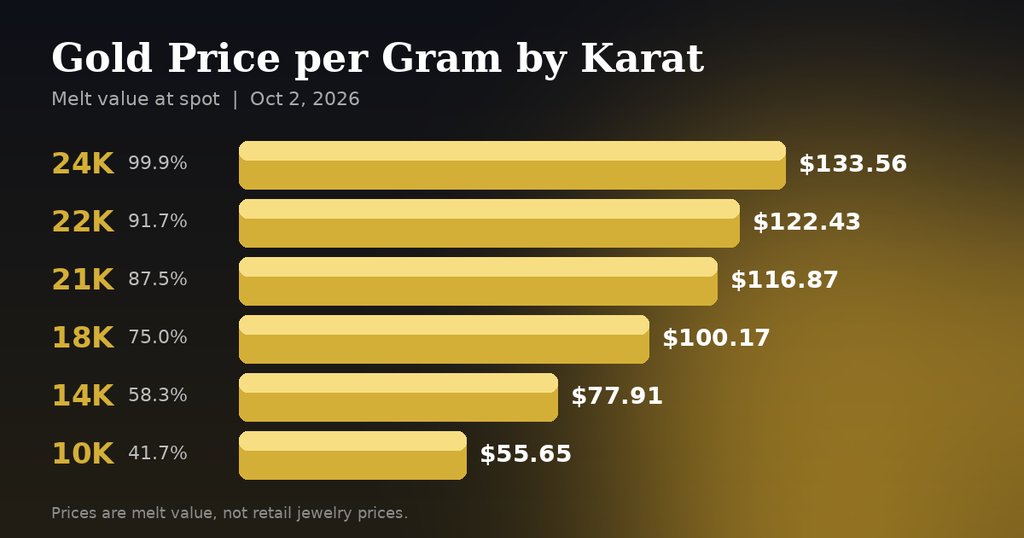
Not all gold is pure gold. Jewelry is usually mixed with other metals such as copper, silver or zinc to make it harder and more durable. The karat number tells you how many parts out of 24 are actual gold. The table below shows the melt value, meaning the raw value of the gold content at today’s spot price. It is not the retail price of a finished piece.
| Karat | Purity | Value per gram | Value per troy ounce |
|---|---|---|---|
| 24K | 99.9% | $133.56 | $4,154.30 |
| 22K | 91.7% | $122.43 | $3,808.20 |
| 21K | 87.5% | $116.87 | $3,635.00 |
| 18K | 75.0% | $100.17 | $3,115.70 |
| 14K | 58.3% | $77.91 | $2,423.20 |
| 10K | 41.7% | $55.65 | $1,731.00 |
To estimate the melt value of your own item, weigh it in grams, multiply by the per-gram value for its karat, and remember that a buyer will normally pay a percentage of that figure, not all of it. For example, a 10-gram 14K chain has a melt value of about $779 at these prices (10 x $77.91), and a scrap buyer might offer somewhere below that.
What Is the Gold Spot Price?
The spot price of gold is the market price for one troy ounce of gold available for immediate delivery. It is quoted in US dollars no matter where you are in the world, and other currencies are converted from that dollar figure. The price is shaped by trading in the over-the-counter market and in gold futures on exchanges such as COMEX, and it updates almost continuously while markets are open.
Spot price vs. retail price
The spot price is a baseline, not a shopping price. When you buy a gold coin or bar, you pay the spot price plus a premium that covers minting or refining, distribution, dealer margin and sometimes insurance and shipping. Smaller items carry a higher premium per ounce than larger ones, and collectible or government-minted coins usually cost more than plain bars. When you sell, you will generally receive a price slightly below spot.
Bid and ask prices
You will often see two numbers: the bid, which is what buyers are willing to pay, and the ask, which is what sellers want. The gap between them is the spread. A tight spread signals a liquid market, and a wide spread (common on small or rare items) means you will give up more when you buy and sell back.
Why the price looks different on different websites
If two sites show prices a few dollars apart, that is usually due to timing, the data feed used, or whether the figure is a bid, an ask or a futures price. These differences are small and normal. What matters is that all reputable sources track the same underlying market.
Why the Gold Price Changes Every Day
Gold pays no interest or dividends, so its price depends largely on how investors feel about other assets and about the economy. Several forces move it at once, and they sometimes pull in opposite directions.
1. The US dollar
Gold is priced in dollars, so the two tend to move in opposite directions. When the dollar strengthens, gold becomes more expensive for buyers holding other currencies, which can weigh on demand and prices. When the dollar weakens, gold often gets a lift.
2. Interest rates and Treasury yields
This is one of the biggest drivers in the current market. Higher interest rates and rising Treasury yields make interest-bearing assets more attractive compared with gold, which earns nothing while you hold it. When yields fall or investors expect fewer rate increases, the “cost” of holding gold drops and prices often rise. Recent trading has shown exactly this pattern, with firmer yields and a stronger dollar putting pressure on gold, and softer economic data easing that pressure.
3. Inflation
Gold has long been seen as a store of value when the purchasing power of money erodes. When inflation runs high or investors fear it will, demand for gold usually rises. The relationship is not perfect, though. If central banks respond to inflation with higher rates, the effect on gold can be mixed.
4. Safe-haven demand and geopolitics
In times of political tension, banking stress, trade disputes or market turmoil, investors often move money into gold as a place to wait out the uncertainty. These spikes in demand can push prices sharply higher in a short time, and they can fade just as quickly when conditions calm down.
5. Central bank buying
Central banks hold gold as part of their reserves, and in recent years many have been net buyers. Steady purchases by large institutions create a deep base of demand that supports prices over the long term.
6. Jewelry and industrial demand
Jewelry is one of the largest uses of gold worldwide, and demand tends to rise around festivals, weddings and holiday seasons in major markets. Gold is also used in electronics and dentistry, although these uses are smaller than investment and jewelry demand.
7. ETF flows and investor positioning
Gold-backed exchange-traded funds and futures positions can amplify moves. When large investors buy, prices can climb quickly, and when they sell or take profits, prices can drop just as fast. This is why gold sometimes moves sharply even without any big news.
Where Gold Has Been: A Short Price History
Context matters when you look at today’s price. Gold crossed $2,000 per ounce for the first time in August 2020 during the early pandemic period, when it passed roughly $2,074. It then entered a long run of higher prices. By April 22, 2025, spot gold had reached about $3,500 per ounce amid tariff announcements and market uncertainty, and it has stayed above $3,000 ever since the first quarter of that year.
Since then, gold has climbed considerably higher, and according to price trackers it has traded above $5,000 an ounce at its peak. At about $4,150 today, the metal sits below that high but remains far above where it traded just a few years ago. In other words, the long-term trend has been strongly upward, with sharp pullbacks along the way.
For anyone thinking about buying, the lesson is simple: gold can rise for years and still drop several percent in a single week. A purchase made at any given price should be judged over a long time horizon, not by a single day’s move.
What Is Moving Gold This Week
Over the past several sessions, gold has been caught between two opposing forces. On one side, firmer Treasury yields and a stronger dollar have limited gains. On the other, softer-than-expected US labor market data has raised hopes that the Federal Reserve will not need to tighten further, which tends to help gold.
The result has been a choppy market, with gold slipping on Friday even as it traded in a wide daily range. Traders are now watching upcoming inflation readings, Federal Reserve commentary and any shift in geopolitical risk for the next clear direction.
What to watch next:
- Inflation reports: Higher-than-expected readings can push rate expectations up, which is usually a headwind for gold.
- Federal Reserve statements: Any change in tone on rates tends to move gold within minutes.
- The US dollar index: A falling dollar often supports gold, while a rising one can cap it.
- Treasury yields: Watch the 10-year yield, which gold often moves against.
- Geopolitical headlines: Sudden risk events can trigger safe-haven buying.
Gold Weight Conversion Table
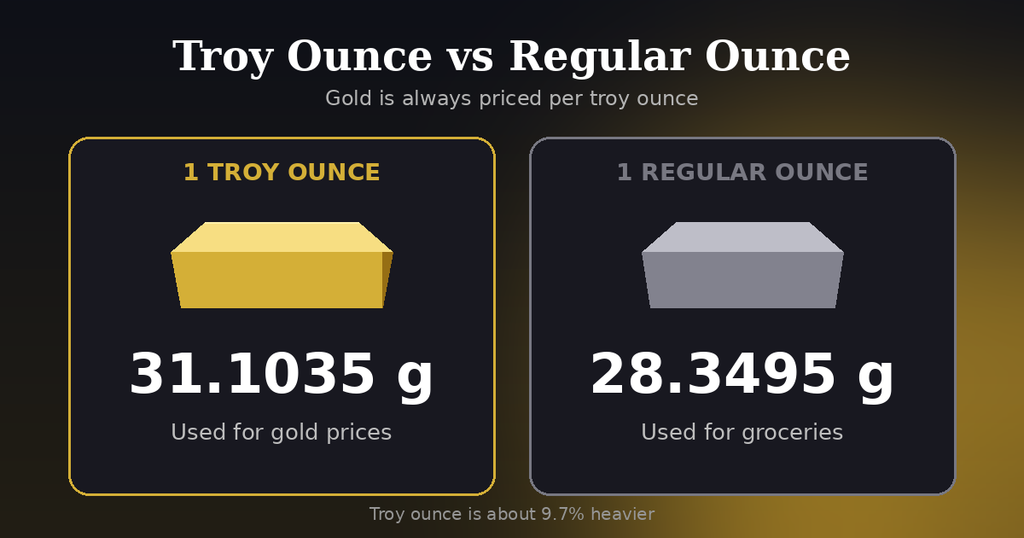
Gold is quoted in troy ounces, not the regular ounces used for groceries. A troy ounce is heavier, and mixing them up is one of the most common beginner mistakes.
| Unit | Equals | Where you see it |
|---|---|---|
| 1 troy ounce | 31.1035 grams | Spot price quotes, coins, bars |
| 1 standard (avoirdupois) ounce | 28.3495 grams | Everyday weights, not used for gold |
| 1 pennyweight (dwt) | 1.5552 grams | Jewelry and scrap gold |
| 1 gram | 0.0322 troy ounces | Small bars, jewelry |
| 1 kilogram | 32.15 troy ounces | Large bars |
Worked example: if you own a 5-gram 22K gold ring, the gold content is worth about 5 x $122.43 = $612 at today’s melt value. If you mistakenly treated the weight as ounces, you would be off by a factor of more than 28, so always double-check the unit.
How to Read Karat Marks and Hallmarks
Genuine gold jewelry in the US is normally stamped with its purity. You may see a karat mark such as 14K, 18K or 24K, or a fineness number such as 585, 750 or 999, which shows parts per thousand of pure gold.
- 10K = 417: the minimum purity that can be sold as gold jewelry in the US.
- 14K = 585: very common in rings and everyday jewelry because it is durable.
- 18K = 750: richer color and higher value, popular in fine jewelry.
- 22K = 916: soft and deep yellow, often used in traditional jewelry.
- 24K = 999: pure gold, mostly used in bars, coins and investment pieces.
Look for a maker’s mark too. Items marked “GP,” “GF,” “GEP” or “HGE” are gold plated or gold filled and have far less gold value than solid gold.
How to Buy Gold Wisely
Buying gold is simple, but a few details can save you real money. Start by deciding what you actually want: investment exposure, a long-term store of value, or jewelry you will enjoy wearing. Each goal points to a different product.
Gold coins
Government-minted bullion coins are widely recognized, easy to resell and available in fractional sizes. They usually carry a higher premium than bars, which you pay for convenience and recognition.
Gold bars
Bars generally have lower premiums per ounce, especially in larger sizes. They are a good choice if you want the most gold for your money, but very large bars can be harder to sell in small pieces.
Gold jewelry
Jewelry is priced well above melt value because of design, labor and brand. Buy it because you love it, not as a pure investment, since you will usually recover only a part of what you paid when you sell.
Always compare the premium, not just the price
Two dealers can quote different totals for the same coin even when the spot price is identical. Compare the premium over spot for the exact product, and add shipping, insurance and any payment fees. A slightly lower headline price can end up costing more once extras are included.
Checklist: Before You Buy Gold
- Check the live spot price and calculate what the item should cost at spot.
- Compare premiums from at least three reputable dealers.
- Confirm weight and purity in writing, including karat or fineness.
- Verify the dealer’s reputation: look for long operating history, clear return policies and real customer reviews.
- Ask about the buyback policy and how the dealer prices a sale back to them.
- Understand storage and insurance: decide whether you will use a home safe, a bank box or a professional vault.
- Keep records: save invoices, certificates and photos for taxes and future resale.
- Avoid pressure tactics. Genuine gold will still be there tomorrow, and urgent “limited time” offers are a warning sign.
Ways to Invest in Gold: Pros and Cons
You do not have to own physical metal to benefit from gold prices. Here is how the main options compare.
| Option | Pros | Cons |
|---|---|---|
| Physical coins and bars | You own the metal directly; no counterparty | Premiums, storage and insurance needs |
| Gold ETFs | Easy to trade in a brokerage account; low cost | No physical possession; fund fees |
| Gold mining stocks | Can rise faster than gold; may pay dividends | Company risk; more volatile than gold |
| Futures and options | High leverage; very liquid | High risk; losses can exceed expectations |
| Digital gold platforms | Small purchases; convenient | Platform and custody risk; check terms |
Many financial professionals suggest that gold, if used at all, should be a modest part of a diversified portfolio rather than the whole thing. The right amount depends on your goals, time horizon and risk tolerance, so consider speaking with a licensed advisor.
A note on taxes
In the US, physical gold and many gold-backed products are generally taxed as collectibles, which can mean a higher maximum long-term capital gains rate than stocks. Rules differ by product and situation, so confirm the details with a tax professional before you sell.
How to Sell Gold and Get a Fair Price
Selling gold is where many people lose money by accepting the first offer. A few habits make a big difference.
- Know your number first. Weigh your items and calculate the melt value using today’s spot price and your karat.
- Get multiple quotes. Compare offers from local coin shops, reputable online buyers and jewelers.
- Understand the payout rate. Buyers pay a percentage of melt value to cover their costs, and the percentage varies widely.
- Watch the scale. Make sure weighing is done in front of you on a certified scale.
- Sell bullion differently from jewelry. Coins and bars often fetch close to spot, while scrap jewelry fetches a lower share.
- Avoid mail-in schemes you do not trust. Use insured shipping and companies with clear written terms.
How to Spot Fake Gold
Counterfeit gold exists, from plated base metal to tungsten-filled bars. No single home test is foolproof, but these checks help you screen items before paying for a professional assessment.
- Magnet test: gold is not magnetic. If the item sticks strongly to a magnet, it is not solid gold, although a non-magnetic result does not prove it is real.
- Hallmark check: look for karat marks and a maker’s stamp, but remember that stamps can be faked.
- Weight and size: gold is very dense, so a coin or bar that feels light for its dimensions deserves suspicion.
- Skin and color check: gold does not turn your skin green or leave a black residue, and it does not tarnish.
- Professional testing: acid kits, electronic testers and X-ray fluorescence (XRF) analysis give much more reliable answers.
The best protection is buying from established dealers who offer authenticity guarantees and a clear return policy.
How to Track the Gold Price Every Day
Because the market moves constantly, the easiest way to stay informed is to build a simple routine.
- Bookmark a live spot price page and check it at the same time each day to spot trends.
- Set price alerts in a brokerage or tracking app so you hear about big moves.
- Follow the major drivers: the dollar, Treasury yields, inflation data and Federal Reserve meetings.
- Remember the weekend: spot gold pauses on weekends, so a Saturday price is the Friday close.
- Keep a log. Writing down the price on the days you check helps you see how far gold has really moved.
Frequently Asked Questions About the Gold Price Today
What is the gold price today?
The last quoted spot price was about $4,154 per troy ounce, or roughly $133.56 per gram, on Friday, October 2, 2026. Because markets are closed on weekends, this remains the latest price on Saturday until trading resumes.
Why did gold go down on Friday?
Gold slipped by roughly $30 as traders balanced firmer yields and a stronger dollar against softer economic data. Moves of this size are common and often reflect changing expectations about interest rates rather than a single piece of news.
How many grams are in a troy ounce?
One troy ounce equals 31.1035 grams. A regular ounce is lighter at 28.3495 grams, so gold prices always refer to the troy ounce.
What is the difference between 24K and 22K gold?
24K gold is about 99.9% pure and is very soft, which is why it is mainly used for bars and coins. 22K gold is about 91.7% gold mixed with other metals, making it harder and better suited to jewelry.
Why is the price I pay higher than the spot price?
Dealers add a premium to cover minting, refining, distribution, insurance and profit. The premium varies by product and size, so compare it across dealers before you buy.
Is gold a good investment right now?
That depends on your goals, time horizon and risk tolerance. Gold has had a strong multi-year run but can fall sharply in short periods. This article is informational, so consider speaking with a licensed financial advisor.
Does the gold price change on weekends?
Spot gold generally does not trade on weekends, so quotes stay at the Friday close until trading reopens on Sunday evening, US Eastern time. Some websites show a static price during this time.
How do I calculate the value of my gold jewelry?
Weigh the item in grams, multiply by the per-gram price for its karat, and expect a buyer to offer a percentage of that melt value. Use the karat table above for a quick estimate.
Conclusion: Use Today’s Gold Price as a Starting Point
The gold price today, about $4,154 per ounce and $133.56 per gram, is the benchmark every buyer and seller works from. But the headline number is only the start. The karat of your item, the dealer’s premium, the weight unit and the timing of your trade all change what you actually pay or receive.
Gold has delivered a remarkable run over the past few years, yet it remains a volatile asset that reacts quickly to the dollar, interest rates and global events. Check live quotes, compare dealers, understand what you are buying and take a long-term view.
Want to stay up to date? Bookmark this page and check back each day for the latest gold price, trend notes and buying tips.
Disclaimer: This article is for general information only and is not financial, investment or tax advice. Gold prices change constantly, and the figures above were taken from market quotes on October 2, 2026. Verify live prices before making any decision.